
Red Crested Pochard Habitat and Nicknames Explained
A male red-crested pochard is hard to miss. With a rounded orange head, coral-red bill and dark chest, it looks more tropical than many ducks seen on European lakes. Yet this handsome diving duck belongs to a wide wetland story that stretches from Spain and France across Central Asia, with wintering birds reaching the Mediterranean, North Africa, the Middle East and parts of South Asia.
Its name sounds simple, but it hides two useful clues: how the bird looks and where it fits among other waterfowl. Its nicknames and local names add even more colour. Some point to its red head. Others describe its crown-like crest or bulbous profile. Together, they help make the species easier to recognise, remember and talk about.
Where the red-crested pochard lives
The red-crested pochard, Netta rufina, is mainly a bird of Europe and Asia, with a range that changes through the year. It breeds in scattered areas across southern and central Europe and farther east through parts of western and central Asia. Its range includes wetland regions around the Mediterranean, the Black Sea and Caspian area, then extends towards Central Asia.
In the colder months, many birds move south or west to milder waters. Wintering birds may be found around western and southern Europe, North Africa, the Middle East and the Indian subcontinent. Some populations migrate strongly, while others move shorter distances or stay close to breeding sites if conditions remain suitable.
Across Europe, good places for the species often include:
Large freshwater lakes
Reed-fringed lagoons
Reservoirs with quiet margins
Gravel pits that have matured into wetlands
Slow waters with rich aquatic plant growth
Brackish wetlands near coasts
The species is patchy rather than evenly spread. One excellent lake may hold many birds, while another nearby site may have none. That is often because the red-crested pochard looks for a fairly specific mix of shelter, open water and food.
In Britain, the species has a more complicated status. It occurs as a visitor and is also linked with introduced or escaped birds from wildfowl collections. Some birds seen in Britain may be part of local feral populations, while others may have a wilder origin. Birdwatchers often assess records by location, timing, behaviour and whether the bird looks fully fit and unringed. Even so, the red-crested pochard has become a familiar possibility at some lakes, reservoirs and gravel pits.
The Red Crested Pochard Habitat and Nicknames Explained topic matters because where the bird lives and what people call it are closely connected. Many of its names come from the same field marks that make it so visible in open wetland habitat.
The habitat it prefers
The red-crested pochard is often grouped with diving ducks, but it does not behave exactly like a classic deep-water diver. It feeds heavily on plant material and often favours shallower areas where underwater vegetation is easy to reach.
Its ideal habitat usually has three key features.
Open water for feeding and safety
Red-crested pochards need open water, both for feeding and for avoiding predators. They often gather on lakes and reservoirs where they can rest away from busy banks. Open water also gives them space to swim, display and move between feeding areas.
Aquatic plants below the surface
This duck eats large amounts of water plants, including leaves, shoots, roots, seeds and algae. It may also take small aquatic animals, especially at certain times of year, but plant food plays a central role. Because of that, healthy submerged vegetation matters.
Clear or moderately clear water often helps aquatic plants grow. If a lake becomes too polluted, too disturbed or too heavily shaded by algal blooms, it may lose the plant life that supports these birds.
Reeds and covered margins for nesting
During the breeding season, reedbeds and thick waterside vegetation become more important. Females need places to hide nests from predators and disturbance. Reed-fringed lakes, marshes and slow backwaters can offer that cover.
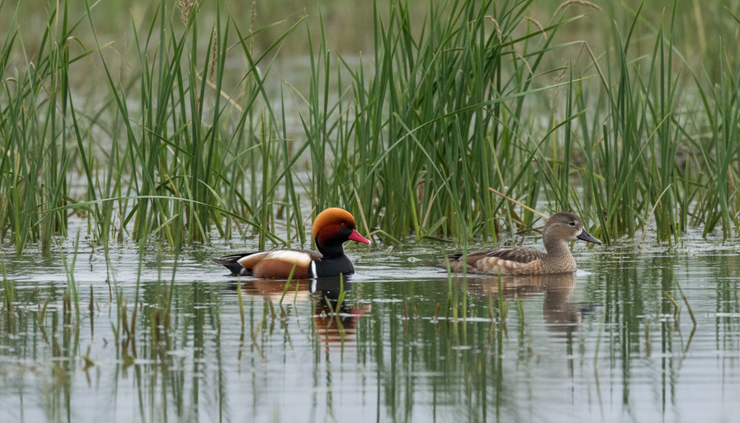
The species may nest close to water, often hidden in dense vegetation. The female does most of the quiet, secretive nesting work, while the bright male is far more obvious before and during courtship.
Why shallow, plant-rich water matters
A red-crested pochard can dive, up-end and dabble near the surface. This flexible feeding style suits lakes where food is not too deep. It often uses areas that are productive rather than dramatic.
A plain-looking gravel pit with clean water and weed beds can be better habitat than a grand lake with bare edges and little underwater growth. This is one reason the species turns up in man-made wetlands. Once old extraction pits, reservoirs or managed nature reserves develop natural margins, they can become suitable for many waterbirds.
Good habitat is not only about the water itself. Low disturbance also matters. Repeated boat traffic, loose dogs, heavy fishing pressure near resting areas or constant human activity can push ducks away from the best feeding and nesting spots.
Seasonal changes in habitat use
In spring and summer, breeding birds need sheltered nesting cover. In autumn and winter, larger open waters become more useful, especially where birds gather in flocks. During cold spells, they may shift to unfrozen areas, larger lakes or coastal lagoons.
Migration also changes what counts as suitable habitat. A lake used only briefly during passage may still be important. It gives birds a safe place to rest and feed before they continue.
How to recognise it in the places it lives
The male red-crested pochard is one of the easier European ducks to identify when in full breeding plumage. The head is rounded and rich orange to rusty red. The bill is bright red or coral-red. The breast and belly area show strong contrast, with a dark chest and paler flanks.
The female is subtler but still distinctive once seen well. She is warm brown above, with pale cheeks and a darker cap. Her bill is darker than the male’s, often with pinkish or reddish tones. At a distance, she can look like several other brown ducks, so head shape and face pattern matter.
A few field marks help separate the species from similar ducks:
Feature | Male red-crested pochard | Female red-crested pochard |
Head shape | Large, rounded, often fluffy-looking | Rounded with a softer profile |
Bill | Bright red, very noticeable | Darker, sometimes with pinkish tones |
Face | Orange to rusty head | Pale cheek patch and darker cap |
Body | Black chest, pale flanks, dark rear | Brown body with gentle contrast |
Usual setting | Open lakes, reed edges, reservoirs | Same habitats, often less conspicuous |
The red-crested pochard is sometimes confused with the common pochard, especially when people only catch a quick view. Male common pochards have a chestnut head too, but their head is smoother, their bill is grey with a dark tip, and their body pattern differs. The red-crested pochard looks warmer, brighter and more rounded in the head.
It may also be compared with the ruddy duck or other reddish-headed waterfowl, depending on the region. In most European contexts, the large orange head and red bill of the drake are the key clues.
Behaviour can help as well. Red-crested pochards often feed in small groups and may mix with other ducks, including mallards, tufted ducks, common pochards and coots. They can be calm on open water, but during the breeding season males become more active and showy.

The nicknames and names people use
The red-crested pochard does not have one famous English nickname used everywhere. Birders may shorten the name in notes, and some may use casual descriptions, but its most meaningful “nicknames” are often local common names in other languages. These names show how people notice the same features in different ways.
Red-crested pochard
The standard English name is very descriptive. “Red-crested” points to the male’s warm orange-red head and raised, rounded crown feathers. “Pochard” places it among a group of diving ducks, although the red-crested pochard has its own feeding style and belongs to the genus Netta, not the same genus as the common pochard.
The word “crest” can be slightly misleading if imagined as a pointed tuft. The bird does not have a sharp crest like a crested tit or a punk hairstyle. Instead, the male’s head feathers create a full, rounded look. In strong light, that rounded head glows orange-red, which makes the name feel exactly right.
Crested pochard
“Crested pochard” is sometimes used informally as a shortened version. It is clear enough in casual speech where no confusion is likely, but the full name is better in writing because several ducks have crests or tufted head feathers.
Red-crested duck
This is more of a plain descriptive phrase than an official name. It may be used by beginners who do not yet know the word “pochard”. It works as a first impression, especially for the male, but it is less precise than the proper common name.
RCP
Among birdwatchers, “RCP” may appear as shorthand in notebooks, lists or quick messages. It is an abbreviation rather than a true nickname. It saves space but should be avoided where readers may not know the code.
Pato colorado
In Spanish, the species is widely known as pato colorado. This can be understood as “red duck” or “coloured duck”, depending on context. It suits the male especially well, as the head and bill carry much of the bird’s visual impact.
The name is simple, memorable and field-friendly. It shows how often common names start with what people see first.
Nette rousse
In French, the bird is called nette rousse. “Rousse” means reddish or russet, again pointing to the warm colour of the male’s head. The word “nette” is linked to the duck group and also appears in the scientific genus name Netta.
French names often have a neat precision, and this one is no exception. It tells you the bird is a reddish member of that waterfowl group without needing a long description.
Kolbenente
The German name Kolbenente is especially interesting. “Ente” means duck, while “Kolben” can refer to a bulb, club or rounded form. The name reflects the drake’s chunky, rounded head shape as much as its colour.
This is a good reminder that not every name focuses on red or orange. Some names capture shape, posture or structure. With the red-crested pochard, the head is not just colourful. It is also unusually full and rounded.
Krooneend
In Dutch, the species is known as krooneend, often understood as “crown duck”. This name points to the male’s high, crown-like head shape. It is one of the most elegant local names for the species because it captures the bird’s regal look on water.
A male in breeding plumage can look almost crowned when sunlight catches the raised orange feathers. The Dutch name turns that impression into a compact label.
What the scientific name says
The scientific name is Netta rufina. Scientific names can look remote at first, but this one is useful.
Netta is the genus. It groups the red-crested pochard with related ducks that share certain features. Rufina refers to reddish colouring, which echoes many of the common names.
So the bird’s formal name and its everyday names all point in the same direction: a duck marked by warm red or russet tones, especially on the male’s head.
Names like these help with memory. Once someone links rufina with reddish, “pato colorado” with red duck, and “krooneend” with crown duck, the species becomes easier to picture even before seeing it again.

Why habitat and names belong together
Bird names are rarely random. They grow from repeated sightings, local language and the features that stand out most. The red-crested pochard is a perfect example.
On open water, the male’s red-orange head is visible from far away. In reed-fringed breeding habitat, the same bright head appears and disappears between stems. On winter lakes, a drake among darker ducks can look like a small flame on the water. It makes sense that so many names refer to redness, crowns or head shape.
The habitat also shapes how people encounter the bird. A species hidden deep in woodland might gather names linked to sound. A bird of cliffs might be named for flight or nesting ledges. The red-crested pochard lives where people can often see it clearly through binoculars, especially on lakes, lagoons and reservoirs. Its names come from sight.
For anyone trying to remember the species, three ideas are enough:
Look for open, plant-rich water
Check reed edges and quiet lake margins
Focus on the rounded red-orange head of the male
Females call for more care, but they often appear near males or in the same suitable habitats. Their pale cheeks, warm brown tones and rounded head shape can still give them away.
The red-crested pochard is more than a colourful duck with a handsome name. It is a wetland specialist tied to healthy aquatic plants, quiet margins and broad seasonal movements. Its nicknames, from “crown duck” to “red duck”, all circle back to the same impression: a bright, rounded-headed bird that brings a flash of warmth to still water.


Comments