
Jay and the Birds of Paradise: Habits, Habitat, and Cob Nut Food
- 3 days ago
- 8 min read

A jay flashing blue through an oak wood can feel as exotic as any tropical bird. It is noisy, intelligent, secretive when it wants to be, and deeply tied to nuts and trees. Birds of paradise, by contrast, live far from British woods, in rainforests where males dance, flare feathers, and turn courtship into theatre.
They are not close relatives in the everyday sense, but they do share a wider bird family story. Both belong to the large order of perching birds, the Passeriformes. That means they sit on branches with the familiar three-toes-forward, one-toe-back foot pattern used by many songbirds. From there, their lives split sharply. Jays are corvids, related to crows, magpies, and ravens. Birds of paradise belong to the family Paradisaeidae, best known from New Guinea and nearby regions.
The link is distant. The contrast is fascinating.

The jay is a clever woodland corvid
The bird most people in Britain call a jay is the Eurasian jay, Garrulus glandarius. It belongs to the crow family, which explains much of its behaviour. Jays are watchful, adaptable, and quick to learn. They can seem shy, yet their harsh screech often gives them away long before they are seen.
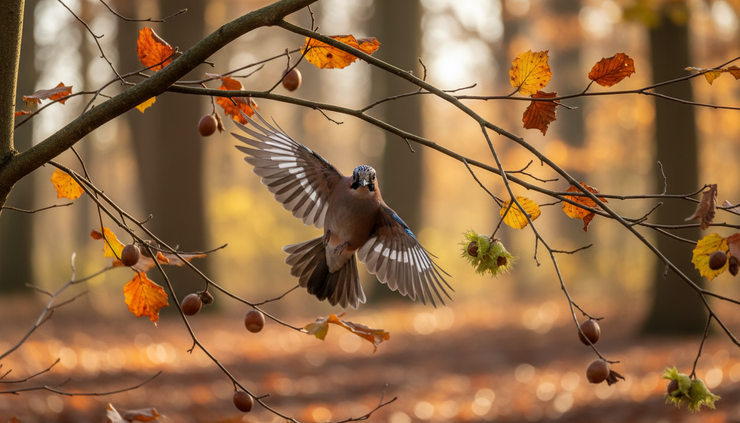
A jay is easy to recognise once it breaks cover. It has a pinkish-brown body, a pale throat, a black moustache mark, a white rump, and a striking blue-and-black barred patch on the wing. In flight, the white rump flashes clearly as the bird slips between trees.
Jays are woodland birds at heart. They favour places with mature trees, cover, and reliable food. In the UK, that often means:
broadleaved woodland
mixed woodland
old parkland
large gardens with trees
hedgerows near woods
wooded farmland edges
They often keep to the canopy or middle branches, especially outside the breeding season. Around people, they can be cautious. In quiet places, they may drop to the ground to feed, bathe, or collect fallen nuts.
The jay’s habits change with the seasons. In spring and summer, it spends more time feeding on insects, caterpillars, beetles, and other protein-rich food. This helps breeding birds and growing chicks. In autumn, the jay becomes a nut gatherer. This is when its role in the woodland becomes especially clear.
Cob nuts, acorns, and the jay’s hidden pantry
When people talk about jays and nuts, acorns usually come first. Jays are famous for collecting acorns and burying them in the ground. This behaviour is called caching. A jay may carry food away from a tree, hide it under leaves, in soil, or among roots, then return later when food is scarce.
Cob nuts fit neatly into this story. A cob nut is a cultivated form of hazelnut, traditionally associated with orchards and gardens, including parts of southern England. To a jay, a cob nut is high-energy food wrapped in a shell. If it can carry it, crack it, or hide it, it is worth attention.
Jays eat several kinds of plant food, including:
acorns
hazelnuts and cob nuts
beech mast
berries
seeds
grain when available
fruit from gardens and orchards
They also eat animal food. A jay’s diet can include insects, spiders, worms, small reptiles, and occasionally eggs or nestlings. That last habit gives jays a mixed reputation among gardeners and birdwatchers, but it is only one part of a broad diet. Jays are opportunists. They take what the season offers.
Their nut-storing habit matters for the wider habitat. Jays do not recover every cached acorn or nut. Some remain buried and germinate. In this way, jays help spread oak and hazel. A forgotten meal can become a tree.
A jay hiding nuts is not just feeding itself. It is also planting the future woodland, one cached seed at a time.
Their memory is impressive. Jays remember many hiding places, and they may move food if they think another bird has been watching. This is typical corvid intelligence. A jay’s world is full of food, risk, memory, and timing.

Where jays live through the year
Jays live across much of Europe, North Africa, and parts of Asia. In Britain, they are widespread where suitable trees and woodland cover exist. They are common enough to be familiar, but their secretive habits mean they are often heard more than seen.
Their ideal habitat has three key features.
They need trees with food
Oaks are especially valuable because of acorns. Hazel, beech, chestnut, berry-bearing shrubs, and fruiting trees also help. A landscape with many food sources supports jays better than a simple row of young trees.
They need cover
A jay does not like feeling exposed for long. Dense branches, woodland edges, and thick hedges give it safe routes. It may cross open ground, but it usually aims for the next tree or hedge.
They need nesting sites
Jays nest in trees or large shrubs. The nest is usually made from twigs, stems, roots, and softer lining material. During the breeding season, they become more discreet. The loud bird of winter can turn surprisingly quiet when nesting.
In towns and villages, jays use parks, cemeteries, gardens, and green corridors. A mature garden with oaks, hazel, shrubs, and quiet corners may attract them. They may visit bird tables, especially for peanuts, but whole natural foods and safe habitat matter more than handouts.
If feeding garden birds, it is best to offer food responsibly. Peanuts should come from a trusted bird food supplier and should not be left mouldy. Whole nuts can be a choking risk for chicks during the breeding season, so mesh feeders are often safer. Natural planting, such as hazel and native shrubs, gives longer-lasting value.
Birds of paradise live a very different life
Birds of paradise are among the most spectacular birds on Earth. Most species live in and around New Guinea, with some in nearby islands and parts of eastern Australia. They are rainforest birds, though different species use different layers and types of forest.
Their habitats include:
lowland tropical rainforest
hill forest
mountain forest
forest edges
secondary growth where suitable food remains
What makes them famous is the male display. Many male birds of paradise have extraordinary feathers, plumes, wires, shields, capes, or iridescent colours. Some transform their shape during courtship so completely that they seem less like ordinary birds and more like moving ornaments.
The display is not random. A male may clear a display branch or forest floor stage. He may call, hop, bow, hang upside down, fan feathers, or pulse coloured throat patches. Females watch and choose. In many species, the female then builds the nest and raises the young alone.
This differs sharply from the jay’s more practical woodland life. Jays are socially complex and intelligent, but they do not have the same extreme courtship style. Their beauty is quieter: blue wing bars, quick movement, sharp calls, and woodland skill.

What jays and birds of paradise have in common
At first, a jay and a bird of paradise seem to have little in common. One hides acorns in British woods. The other displays in tropical rainforest. Yet they share a few important traits.
Both are perching birds. Their feet are built for gripping branches. Both depend strongly on trees. Both use intelligence and sharp senses to survive in complex habitats.
They also both show how birds adapt to food.
A jay’s body and behaviour suit a temperate woodland where food changes with the seasons. Autumn brings nuts. Winter brings scarcity. Spring brings insects. The jay survives by remembering, hiding, and switching diet.
Birds of paradise often feed on fruit and small animals such as arthropods. Fruit is especially important for many species. In tropical forests, fruiting trees can be scattered and seasonal in different ways from British oaks and hazels. Birds must move through the forest and track food across space.
There is also a shared link with seed movement. Jays spread acorns and nuts by caching them. Fruit-eating birds of paradise may spread seeds after eating fruit. In both cases, birds help shape forests.
The difference lies in emphasis. Jays are famous for storing. Birds of paradise are famous for display. Both habits make sense in their own places.
Their food tells the story of their habitats
Food is one of the clearest ways to compare these birds.
Jay | Birds of paradise |
Lives mainly in temperate woodland, parks, and wooded countryside | Lives mainly in tropical forests, especially around New Guinea |
Eats acorns, cob nuts, hazelnuts, beech mast, insects, eggs, and fruit | Eats fruit, arthropods, and small animals, depending on species |
Stores nuts and seeds for later | Moves through forest to find fruiting trees and prey |
Helps spread oaks and hazels | Helps spread rainforest seeds |
Uses memory and caution to manage seasonal scarcity | Uses display, colour, and movement in mate choice |
The jay’s relationship with cob nuts is a good example of local adaptation. In a British garden, orchard, or hazel-rich woodland, cob nuts are a rich seasonal prize. The bird must judge when they are worth taking, where to carry them, and where to hide them.
Birds of paradise face different choices. A male may need a display perch that catches the right light. A female may judge display quality, health, movement, and territory. Food still matters, but courtship has driven some species into astonishing forms.
The jay’s reputation deserves a fair look
Jays often divide opinion. Some people admire their colours and intelligence. Others dislike them because they may raid nests or take food from feeding stations. Both views contain some truth, but neither tells the whole story.
A jay is not a villain in the woodland. It is a native bird doing what corvids do: exploring, testing, eating, caching, watching, and adapting. Nest predation happens in nature, and many species take eggs or chicks when they can. At the same time, the jay’s seed-spreading role is valuable. Oaks, hazels, and other trees benefit when birds move seeds away from the parent tree.
Seeing the jay whole means accepting its complexity. It is beautiful and noisy. Helpful and predatory. Shy and bold. Common in some places, hard to spot in others.
Birds of paradise also suffer when reduced to one trait. Their courtship displays are famous, but they are not just decorative birds. They are forest animals with feeding routes, calls, territories, nesting needs, and ecological roles.
How to watch for jays without disturbing them
The best way to notice jays is to listen first. Their harsh, rasping call often rings out from woodland edges. They also mimic other sounds at times, including calls of other birds. Once one calls, watch for movement between trees rather than waiting for it to sit in the open.
Good places to look include oak woods, hazel coppice, old parkland, and large gardens near mature trees. Autumn is especially rewarding because jays are busy collecting acorns and nuts. They may fly repeatedly between feeding trees and caching spots.
A few simple habits help:
Stand still near a woodland edge and let the birds settle.
Watch oak and hazel trees in autumn.
Look for the white rump as the bird flies away.
Avoid approaching nests or alarm-calling birds in spring.
Keep dogs under close control in sensitive woodland.
Binoculars make a big difference. A jay’s colours are richer than they first appear, especially the blue wing panel. In dull light, the bird may look mostly brown and pale. In a clear view, it becomes one of Britain’s most attractive woodland birds.
A distant family link, but a shared dependence on forests
Jays and birds of paradise are not close cousins like a carrion crow and a rook. Their relationship is much broader. They sit on separate branches of the perching bird family tree. That distance matters because it keeps the comparison honest.
Still, their stories meet in the trees.
The jay shows how intelligence, memory, and food storage help a bird survive in a seasonal woodland. Its taste for acorns, hazelnuts, and cob nuts links it to the future of oaks and hazels. Birds of paradise show how tropical forests can shape colour, movement, display, and mate choice over long periods.
One bird hides food under fallen leaves. Another dances in filtered rainforest light. Both remind us that habitat is not just scenery. It shapes what birds eat, how they move, how they breed, and how they survive.
The next time a jay shrieks from an oak or flashes blue through a British wood, it is worth giving it a longer look. Its world may be closer to home than that of the birds of paradise, but it is no less remarkable.


Comments